Blog
Cellular Dead Zones
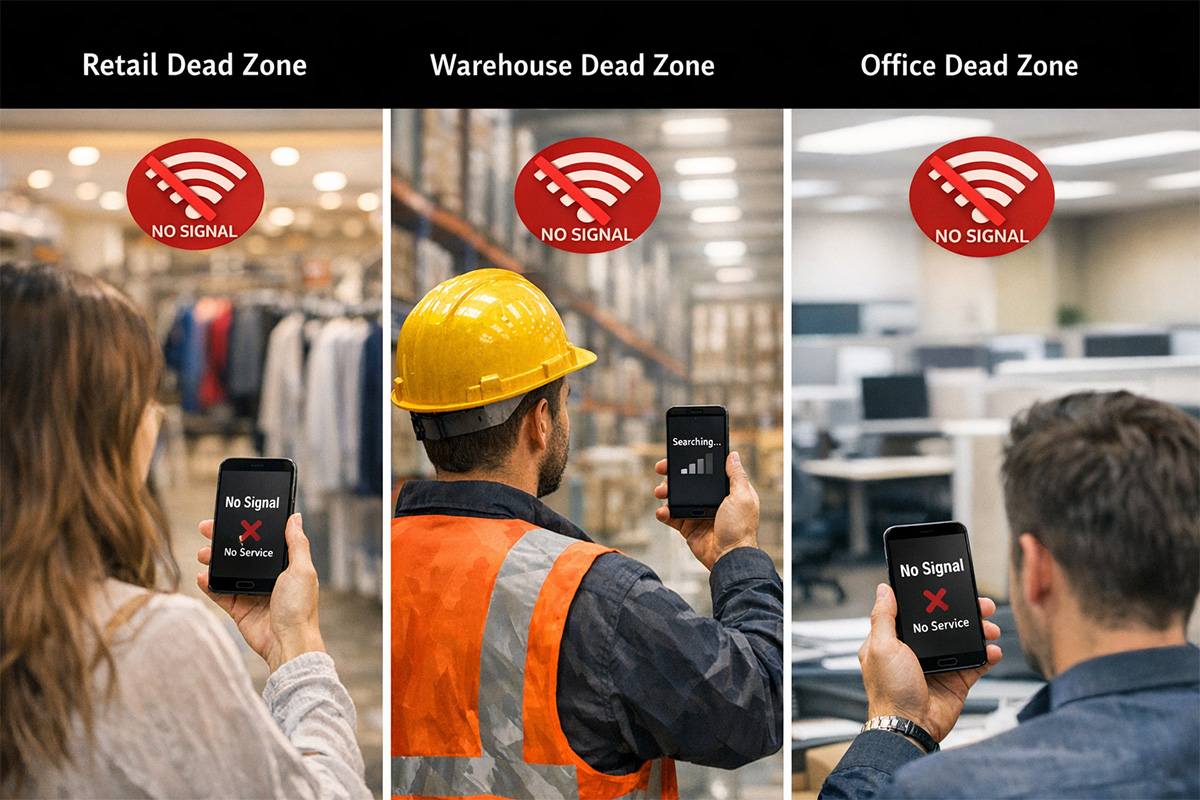
A warehouse worker misses a critical safety alert. A retail associate can't process a payment. A remote employee drops a client call for the fifth time this week.
Cellular dead zones are more than a nuisance in homes, offices, warehouses, schools, and remote facilities. Weak signals disrupt calls, throttle data speeds, and create costly communication gaps. Cell‑Fi technology is engineered to solve that problem, improving indoor and hard-to-reach cellular coverage with a smart, carrier-approved approach that outperforms traditional solutions.

ERCES Vs. Cellular Explained:
Why First Responders Can't Afford Dead Zones
A plain-language and technically rigorous guide to Emergency Responder Communications Enhancement Systems
A dropped call in a parking garage is annoying. You lose your place in the podcast, you reschedule the meeting, and you walk outside to call back. It's an inconvenience.
Now put a firefighter in that same parking garage. Radio contact drops. Incident command can't reach the crew on the third subterranean level. The fire is spreading. That's not an inconvenience. That's a life-safety failure.
That distinction—between commercial cellular convenience and emergency radio reliability—is the entire reason Emergency Responder Communications Enhancement Systems (ERCES) exist. It's also why they've moved from a nice-to-have to a hard legal mandate in most U.S. jurisdictions. If your building doesn't have a compliant system, it may not pass inspection. If it has a poorly designed one, your AHJ can shut occupancy down until you fix it.

HCI is the leading Motorola Solutions Channel Partner in Houston , Texas. We have been serving our clients for over 40 years.
Texas Security License: B24122601
Navigation
Popular Links
Contacts
Locations:
HCI
1105 Industrial Blvd.
Sugar Land, TX 77478
281-491-1616
HCI Dallas (Formerly Blair Communications, Inc.)
11407 Goodnight Lane
Dallas, TX 75229
972-247-4901
E-mail: Contact Us

